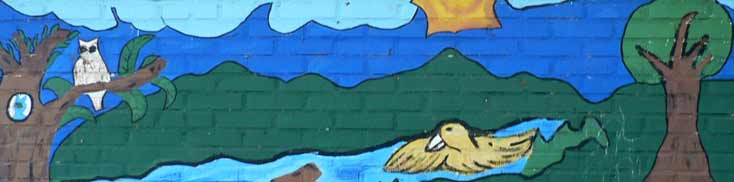
Click image for details and additional images.
In 2003, the community of Yryapú was forced, through the enactment of a Master Plan by the government of Misiones Province, to relocate within a 600 hectare area that was slated for tourist hotel development. The people of Yryapú were given title to 265 hectares of land, however they were left with numerous problems including the loss of food and forest resources that they needed to rebuild their community. Although the village was close to Puerto Iguazú and the Iguazú Waterfalls, the residents had not engaged in many tourism activities, other than making baskets and handicrafts for sale to tourists visiting the waterfalls.
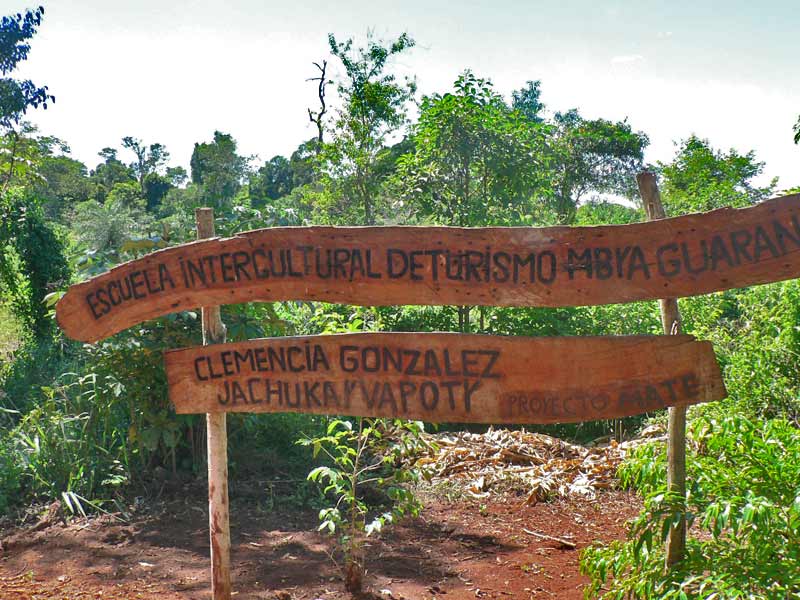
The idea of building a training school for indigenous guides in the community was seen as a way to promote sensitive tourism of indigenous people and to provide an income for young men and women from a number of Mbya communities. The idea, developed by Francisco Javier Franco, of Yryapú, and his friend Claudio Salvador, a radio and internet journalist from Puerto Iguazú, led to a series of meetings with the government of Misiones Province and the Canadian International Development Agency in 2005. These meetings led to the formation of an educational training program called the Argentine Model for Tourism and Employment, or Project MATE. Niagara College of Canada provided technical support to the program through its Instituto Tecnológico Iguazú in Puerto Iguazú. The one-room school building was constructed in 2006 with money donated from a variety of organizations and local agencies. It was named Escuela Intercultural de Turismo Mbya Guaraní, Clemencia Gonzalez Yachuka Yvapoty for its spiritual leader.
Classes began in 2007 with teaching content in both the Mbya and Spanish languages. Elders from a number of Guaraní communities in Argentina and Paraguay were videotaped as they explained nine different traditional cultural practices, including knowledge of the rainforest ecosystem flora and fauna, food collection and preparation, music, and using forest resources for handicrafts. These tapes were used as part of the teaching curriculum. Additionally, students learned about the national culture in the training sessions. The students were also trained to deal with situations and questions that they might encounter when guiding tourists. More than 50 Mbya and Chiripá Guaraní from Argentina, Paraguay, and Brazil have graduated from these 11-week training courses. These students have the opportunity to write and share brief stories about their culture, special events, and their own graduation ceremonies over a web site operated by Claudio Salvador. On October 12, 2011 individuals from the school participated in the newly designated National Day of Respect for Diverse Cultures in an intercultural ceremony to honor the memory of the indigenous pueblos that were lost during the conquest 509 years ago. The accomplishments of the school have brought a sense of pride and empowerment to many of the residents of Yryapú.
The initial operating costs of the school were covered through a grant from Niagara College of Canada. It is currently funded through a grant from the Inter American Foundation of Washington, D.C.
To learn more about the Project MATE school, please visit its website at http://www.proyectomate.org/